
Contents
Overview
Differential geometry traces its roots to antiquity with early studies in spherical geometry for astronomy and Earth's geodesy. The 17th century brought calculus, enabling analysis of plane curves' arc lengths and areas, as pioneered by René Descartes. Carl Friedrich Gauss's 1827 theorema egregium proved Gaussian curvature is an intrinsic property, independent of embedding space, marking the shift to intrinsic geometry. Bernhard Riemann's 1854 habilitation lecture generalized surfaces to n-dimensional manifolds, laying foundations for modern differential geometry. By the late 19th century, it expanded to differentiable manifolds with geometric structures defining distance, angle, and volume.
⚙️ How It Works
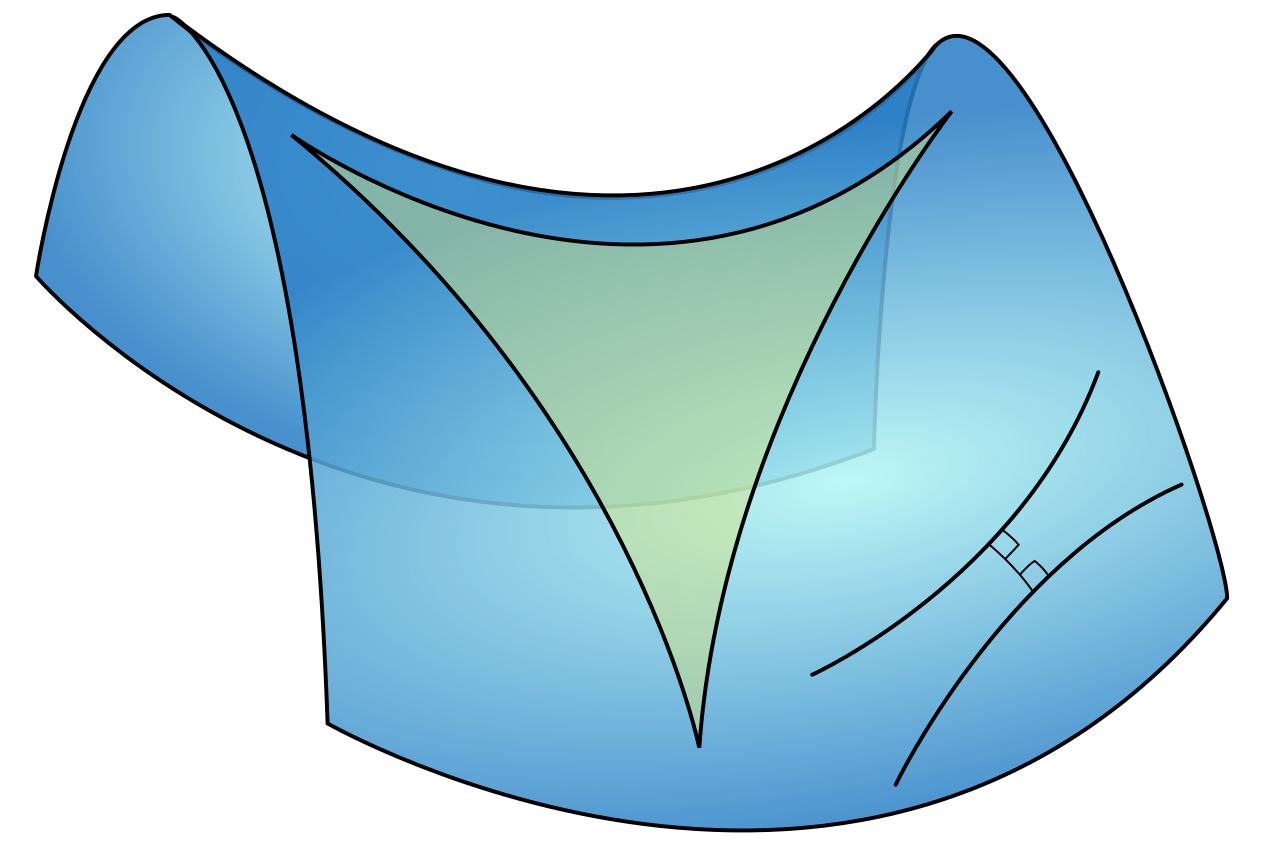
At its core, differential geometry applies vector calculus, linear algebra, and multilinear algebra to smooth manifolds—spaces locally resembling Euclidean space. Key concepts include curvature (Gaussian curvature as the product of principal normal curvatures), measured intrinsically without external reference. Tools like tangent spaces at each point allow vector fields and derivatives on manifolds, with differential forms and de Rham cohomology analyzing global properties. Riemannian geometry equips manifolds with a metric tensor for distances and angles; symplectic geometry preserves volumes. Branches include differential topology (metric-free invariants), discrete differential geometry (computational approximations), and geometric analysis linking to partial differential equations.
🌍 Cultural Impact
Differential geometry permeates physics, underpinning general relativity where spacetime is a curved Lorentzian manifold, as in Einstein's field equations. In engineering and robotics, it models motion paths and optimizes trajectories; computer graphics uses it for surface rendering and animation. Architecture leverages curvature for tensile structures, while geophysics applies it to Earth's shape. Economics models utility surfaces, and cosmology explores universe geometries. Its ideas echo in art through non-Euclidean perspectives and in philosophy via intrinsic vs. extrinsic reality debates.
🔮 Legacy & Future
The 20th century saw differential geometry fuel breakthroughs like gauge theory in particle physics and string theory's Calabi-Yau manifolds. Future frontiers include applications in machine learning for manifold learning, quantum computing via geometric phases, and AI-driven geometry proofs. Challenges persist in higher-dimensional generalizations and computational discrete analogs. As quantum gravity and artificial intelligence advance, differential geometry will remain central, potentially unifying geometry with topology in exotic structures like orbifolds.
Key Facts
- Year
- 19th-20th century
- Origin
- Europe (Germany, Russia)
- Category
- science
- Type
- concept
Frequently Asked Questions
What distinguishes intrinsic from extrinsic curvature?
Intrinsic curvature, like Gaussian curvature, is measurable from within the surface without external embedding, as proven by Gauss's theorema egregium. Extrinsic curvature depends on how the surface sits in ambient space, such as a cylinder's zero Gaussian but non-zero extrinsic bend. Planes and cylinders share zero Gaussian curvature and are locally isometric, flattenable without distortion.
How does differential geometry apply to general relativity?
Spacetime is modeled as a 4D Lorentzian manifold with curvature dictated by mass-energy via Einstein's equations. Geodesics become straightest paths for light and particles in curved space, explaining gravity. Riemannian metrics define distances warped by matter.
What is a smooth manifold?
A Hausdorff topological space locally homeomorphic to Euclidean space, with smooth transition maps between charts (diffeomorphisms). This allows calculus tools like tangent spaces and vector fields at every point. Examples include spheres, tori, and abstract phase spaces.
What are key branches of differential geometry?
Riemannian geometry studies metrics for distances/angles; symplectic for volume-preserving flows in mechanics; conformal preserves angles; differential topology examines smooth invariants without metrics. Discrete versions approximate for computation.
Why is differential geometry important in computer graphics?
It models surface curvatures for realistic shading, normal mapping, and deformations. Discrete differential geometry discretizes concepts for mesh processing, subdivision surfaces, and physics simulations in games and animation.
References
- study.com — /academy/lesson/differential-geometry-overview.html
- en.wikipedia.org — /wiki/Differential_geometry
- britannica.com — /science/differential-geometry
- damtp.cam.ac.uk — /user/tong/gr/two.pdf
- math.ou.edu — /~npetrov/final-paper-nathan-leiphart.pdf
- math.toronto.edu — /laithy/3672021/DiffGeomNotes_short.pdf
- youtube.com — /watch
- maa.org — /review_topics/differential-geometry/