
Contents
- 🎵 Origins & History
- ⚙️ How It Works
- 📊 Key Facts & Numbers
- 👥 Key People & Organizations
- 🌍 Cultural Impact & Influence
- ⚡ Current State & Latest Developments
- 🤔 Controversies & Debates
- 🔮 Future Outlook & Predictions
- 💡 Practical Applications
- 📚 Related Topics & Deeper Reading
- Frequently Asked Questions
- References
- Related Topics
Overview
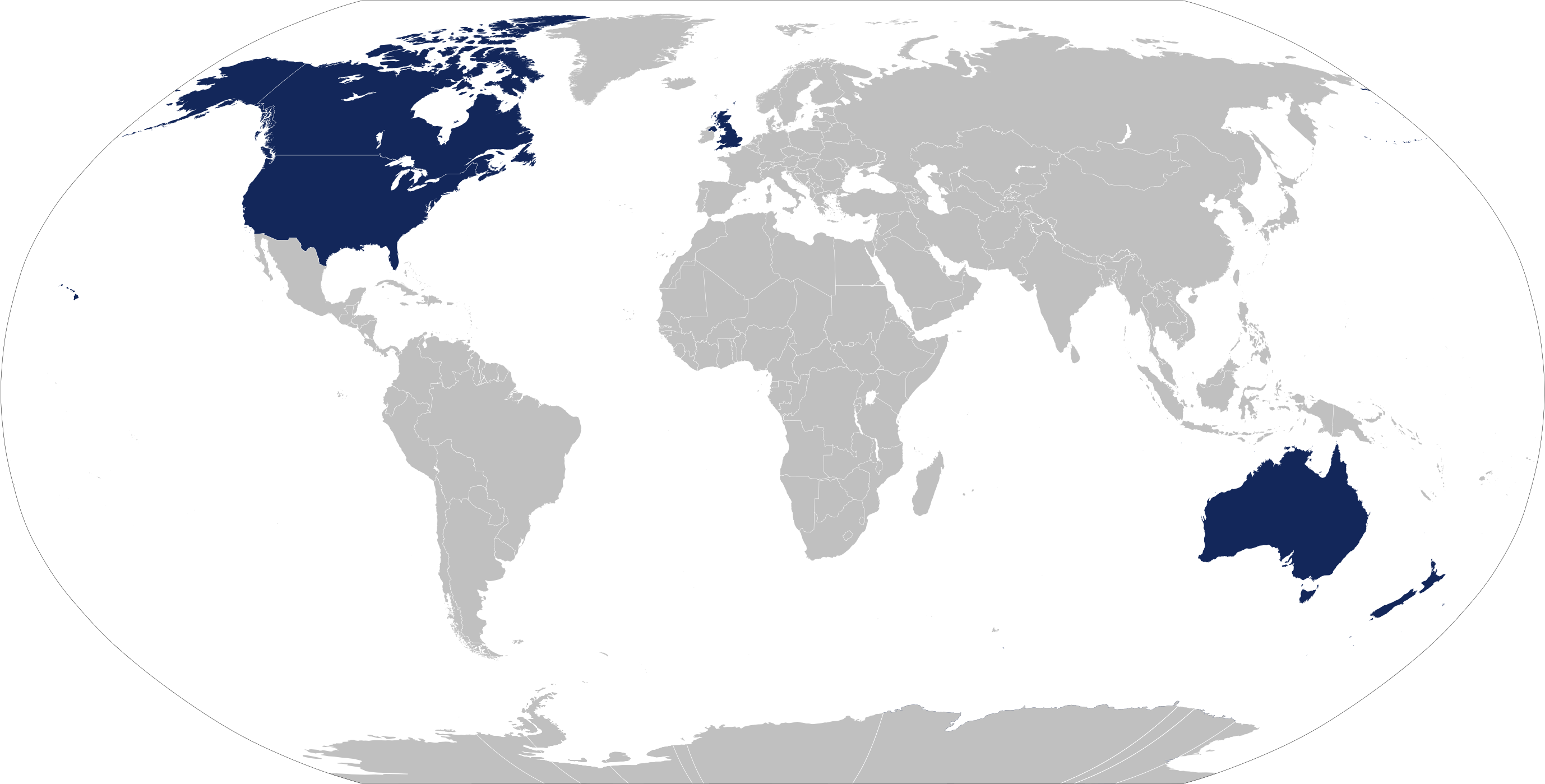
The genesis of the Five Eyes can be traced back to the clandestine code-breaking efforts between British and American cryptanalysts during World War II, even before the United States' formal entry into the conflict. These early, informal exchanges laid the groundwork for a more structured collaboration. The alliance was officially cemented in 1946 with the signing of the UKUSA Agreement, a secret treaty designed to facilitate the sharing of signals intelligence between the United Kingdom and the United States. As the Cold War intensified, the scope of cooperation broadened, leading to the inclusion of Canada, Australia, and New Zealand, transforming the bilateral pact into the multilateral FVEY. This post-war formalization marked a significant escalation in coordinated intelligence gathering, establishing a framework that would endure for decades and adapt to new technological landscapes, including the development of early global surveillance networks like ECHELON in the 1960s.
⚙️ How It Works
At its core, the Five Eyes operates on the principle of reciprocal SIGINT sharing, governed by the UKUSA Agreement. Member nations' intelligence agencies, such as the National Security Agency (US), Government Communications Headquarters (UK), Communications Security Establishment (Canada), Australian Signals Directorate (Australia), and New Zealand Intelligence Security Service (New Zealand), collaborate to collect, analyze, and disseminate intelligence. The alliance employs a complex system of caveats, such as 'AUS/CAN/NZ/UK/US Eyes Only,' to control the dissemination of sensitive information. This framework allows member states to pool their technical capabilities and intelligence assets, effectively creating a unified global surveillance network that can monitor communications across vast swathes of the globe, often circumventing national restrictions by having another member nation collect information on its own citizens.
📊 Key Facts & Numbers
The scale of the Five Eyes' operations is staggering, though precise figures remain largely classified. It is estimated that FVEY agencies collect trillions of data points annually, encompassing internet traffic, phone calls, and satellite communications. The National Security Agency alone reportedly collects over 150 million internet records daily, a significant portion of which is shared with its FVEY partners. The ECHELON surveillance system, a precursor to modern FVEY operations, was capable of monitoring an estimated 90% of all global internet traffic by the early 2000s. The collective annual budget for FVEY intelligence agencies is estimated to be in the tens of billions of dollars, reflecting the immense resources dedicated to maintaining their global intelligence-gathering apparatus. The alliance's reach extends to over 190 countries, making it arguably the most extensive intelligence network in history.
👥 Key People & Organizations
Key figures instrumental in the formation and evolution of the Five Eyes include individuals like Alastair Dennistoun, a British cryptographer involved in early wartime discussions, and William Cave-Browne-Cave, another British codebreaker. Post-war, figures within the US National Security Agency and its counterparts in the other member nations, such as Paul N. Niblack (NSA), played crucial roles in formalizing the UKUSA Agreement. Organizations like the National Security Agency, Government Communications Headquarters, Communications Security Establishment, Australian Signals Directorate, and the New Zealand Intelligence Security Service are the operational arms of the FVEY. More recently, whistleblowers like Edward Snowden have brought the alliance's activities into public view, highlighting the roles of individuals within these agencies who have either facilitated or exposed its operations.
🌍 Cultural Impact & Influence
The Five Eyes has profoundly shaped global perceptions of privacy and national security. Its existence, often revealed through leaks like those by Edward Snowden in 2013, has fueled widespread public concern and debate about government surveillance. The alliance's operations have influenced international relations, leading to diplomatic tensions and calls for greater transparency from non-member nations. Culturally, FVEY activities have inspired numerous books, films, and documentaries, such as Oliver Stone's Snowden (2016), which explore themes of espionage, privacy, and the power of intelligence agencies. The concept of 'Eyes Only' caveats has also seeped into popular culture, symbolizing extreme secrecy and restricted access to information, underscoring the alliance's pervasive, albeit often unseen, influence on global discourse.
⚡ Current State & Latest Developments
In the current geopolitical climate of 2024-2025, the Five Eyes remains a highly active and critical intelligence-sharing partnership. The alliance is increasingly focused on emerging threats, including cyber warfare, disinformation campaigns orchestrated by state actors like Russia and China, and the proliferation of advanced technologies. Recent reports suggest enhanced cooperation on artificial intelligence (AI) and quantum computing for intelligence purposes. Following the Israel-Hamas War, FVEY nations have also intensified intelligence sharing related to counter-terrorism and regional stability. The alliance continues to adapt its methods to the evolving digital landscape, with ongoing discussions about expanding membership or creating closer ties with nations like Japan and South Korea, signaling a potential broadening of its strategic reach.
🤔 Controversies & Debates
The Five Eyes is perennially embroiled in controversy, primarily concerning the balance between national security and individual privacy. Critics, including civil liberties organizations like the American Civil Liberties Union, argue that the alliance's vast surveillance capabilities infringe upon fundamental human rights and democratic principles. The practice of 'backdoor searches,' where one FVEY member collects data on another member's citizens and shares it, is a particularly contentious issue. Furthermore, the alliance has faced accusations of overreach, including alleged spying on political dissidents and foreign governments not aligned with FVEY interests. Debates also rage over the legal frameworks governing data collection and the extent of oversight applied to these powerful intelligence agencies, with ongoing legal challenges in various member states questioning the legality and proportionality of FVEY operations.
🔮 Future Outlook & Predictions
The future trajectory of the Five Eyes is likely to be shaped by rapid technological advancements and evolving global threats. Experts predict an increased emphasis on artificial intelligence and machine learning for predictive analysis and threat detection, potentially leading to more sophisticated and pervasive surveillance capabilities. The alliance may also explore closer integration with emerging technologies like 5G networks and the Internet of Things (IoT) for expanded data collection. Geopolitically, the rise of China as a global power is expected to remain a primary driver for FVEY cooperation, potentially leading to more assertive joint operations and intelligence sharing. However, internal pressures related to privacy concerns and potential membership expansion with nations like Japan could also redefine the alliance's structure and operational parameters in the coming decade.
💡 Practical Applications
The practical applications of the Five Eyes' intelligence gathering are far-reaching, underpinning national security efforts across member states. This includes counter-terrorism operations, such as tracking and disrupting plots identified through intercepted communications, and cybersecurity initiatives aimed at defending critical infrastructure from state-sponsored or criminal cyberattacks. The intelligence shared by FVEY agencies informs foreign policy decisions, military planning, and law enforcement investigations, ranging from tracking transnational criminal organizations to monitoring the proliferation of weapons of mass destruction. For instance, intelligence derived from FVEY cooperation has been instrumental in identifying and neutralizing threats posed by groups like ISIS and in understanding the strategic intentions of rival nations. The data collected also aids in economic intelligence, providing insights into global markets and technological developments.
Key Facts
- Year
- 1946
- Origin
- United Kingdom / United States
- Category
- technology
- Type
- organization
Frequently Asked Questions
What is the primary purpose of the Five Eyes alliance?
The primary purpose of the Five Eyes is to facilitate the sharing of signals intelligence (SIGINT) among its five member nations: Australia, Canada, New Zealand, the United Kingdom, and the United States. This cooperation allows them to pool resources and expertise for global intelligence gathering, focusing on national security threats, counter-terrorism, and monitoring foreign adversaries. The alliance operates under the framework of the secret UKUSA Agreement, enabling a coordinated approach to collecting and analyzing communications data from around the world.
How did the Five Eyes alliance originate?
The origins of the Five Eyes trace back to informal, secret meetings between British and American code-breakers during World War II. These wartime collaborations proved so effective that they were formalized in 1946 with the signing of the UKUSA Agreement between the UK and the US. The alliance expanded in the post-war era to include Canada, Australia, and New Zealand, solidifying its structure as a multilateral intelligence-sharing pact designed to counter emerging global threats during the Cold War.
What are the main criticisms leveled against the Five Eyes?
The Five Eyes faces significant criticism primarily concerning its extensive surveillance capabilities and the impact on digital privacy. Critics argue that the alliance's operations, often conducted in secrecy, infringe upon the civil liberties of citizens worldwide. Specific concerns include 'backdoor searches,' where one member nation collects data on another's citizens and shares it, and the potential for misuse of intelligence for political or economic gain. Organizations like the American Civil Liberties Union have consistently called for greater transparency and oversight of FVEY activities, highlighting the tension between national security imperatives and fundamental human rights.
Which intelligence agencies are part of the Five Eyes?
The Five Eyes comprises the principal signals intelligence agencies of its member nations. These include the National Security Agency (NSA) in the United States, Government Communications Headquarters (GCHQ) in the United Kingdom, Communications Security Establishment (CSE) in Canada, the Australian Signals Directorate (ASD) in Australia, and the New Zealand Intelligence Security Service (NSS) in New Zealand. These agencies are the operational arms responsible for collecting, processing, and disseminating intelligence under the FVEY framework.
How has the digital age impacted the Five Eyes' operations?
The digital age has dramatically expanded the scope and capabilities of the Five Eyes. The proliferation of the internet, mobile devices, and the Internet of Things has created unprecedented volumes of data for collection and analysis. FVEY agencies have leveraged advancements in artificial intelligence and big data analytics to process this information, enabling more sophisticated surveillance and threat detection. However, this digital transformation has also amplified privacy concerns and led to new challenges in securing communications against increasingly sophisticated cyber threats, as highlighted by revelations from Edward Snowden.
Can non-member countries cooperate with the Five Eyes?
Yes, non-member countries can and do cooperate with the Five Eyes, though typically under more restricted terms. Alliances like the Nine Eyes and Fourteen Eyes represent broader networks of intelligence cooperation that include FVEY members and additional countries. These partnerships often focus on specific areas of mutual interest, such as counter-terrorism or cybersecurity, and may involve sharing intelligence on a case-by-case basis. However, the depth and breadth of intelligence sharing are generally more limited compared to the core FVEY partnership, due to differing levels of trust and operational protocols.
What is the future outlook for the Five Eyes alliance?
The future of the Five Eyes appears robust, driven by persistent global security challenges and technological evolution. Key trends include a greater reliance on artificial intelligence for intelligence analysis, increased focus on countering state-sponsored cyber threats from nations like China, and potential collaborations with Asian allies such as Japan and South Korea. While privacy debates will undoubtedly continue, the alliance's foundational role in national security and its adaptability to new technological paradigms suggest it will remain a significant force in global intelligence for the foreseeable future. The challenge will be balancing operational effectiveness with public trust and democratic accountability.