
Contents
- 📜 What Are Hieroglyphs? A Practical Intro
- 📍 Where to Encounter Hieroglyphs Today
- 💡 Key Concepts for Understanding Hieroglyphs
- 📚 Essential Resources for Learners
- ⭐ What People Say: The Vibe of Hieroglyph Study
- ⚖️ Hieroglyphs vs. Other Ancient Scripts
- 🛠️ Tools for Decoding: From Rosetta Stone to Apps
- 🔮 The Future of Hieroglyph Interpretation
- Frequently Asked Questions
- Related Topics
Overview
Hieroglyphic script, the iconic writing system of ancient Egypt, offers a captivating window into a civilization that shaped millennia. Emerging around 3200 BCE, these intricate symbols, ranging from phonetic signs to ideograms and determinatives, adorned temple walls, papyri, and tombs, recording everything from religious rituals and royal decrees to daily life. While often perceived as purely pictorial, hieroglyphs represent a complex linguistic system that took centuries to decipher, most famously unlocked by the Rosetta Stone and the work of Jean-François Champollion in the 1820s. Understanding hieroglyphs is not just an academic pursuit; it's an act of cultural archaeology, revealing the worldview, beliefs, and administrative prowess of one of history's most enduring empires. The script's influence, though largely dormant for centuries, continues to resonate in art, symbolism, and our enduring fascination with the ancient world.
📜 What Are Hieroglyphs? A Practical Intro
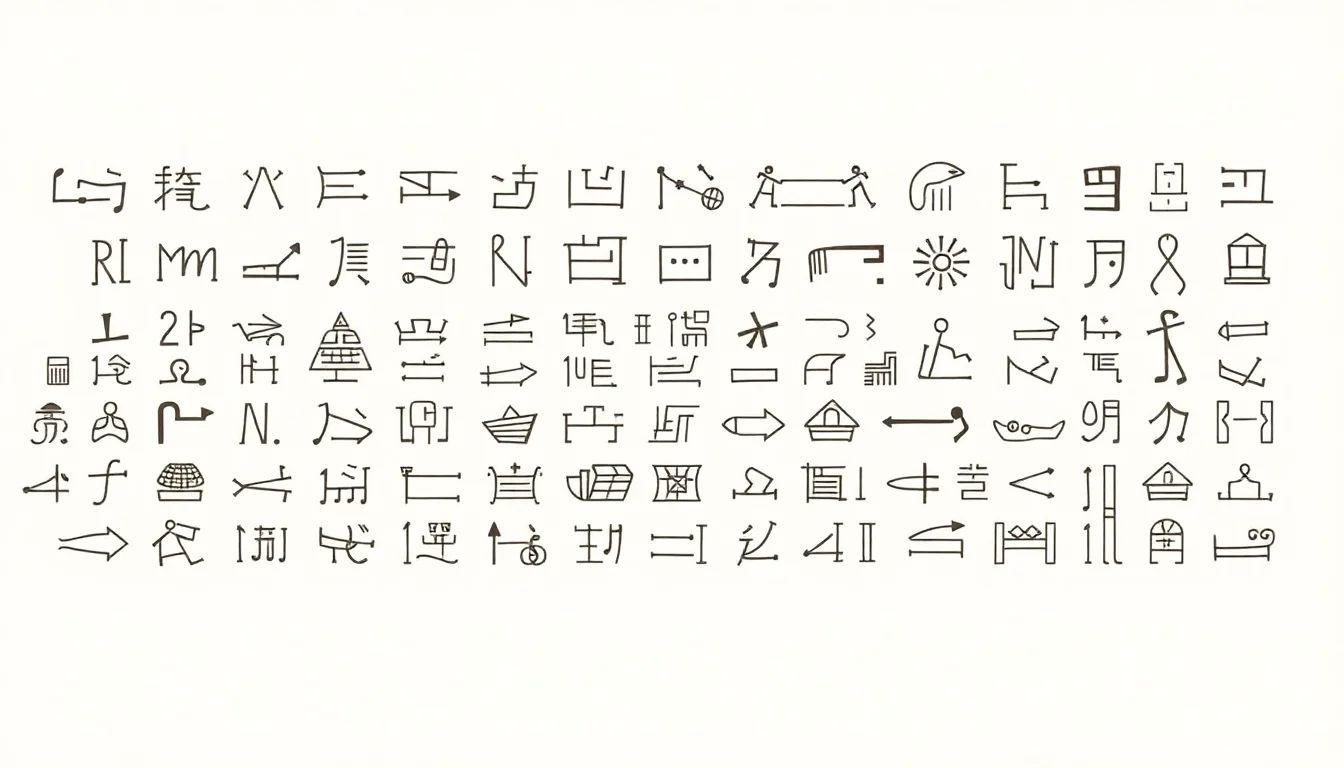
Hieroglyphic script, the sacred carvings of ancient Egypt, isn't just pretty pictures; it's a sophisticated writing system that offers a direct window into a civilization that thrived for over 3,000 years. Developed around 3200 BCE, these symbols, ranging from birds and reeds to human figures and geometric shapes, could represent sounds (phonograms), whole words (logograms), or even clarify the meaning of other signs (determinatives). Understanding hieroglyphs unlocks a treasure trove of religious texts, historical records, and personal stories, providing unparalleled insight into the Egyptian worldview and daily life. This isn't a dead language; it's a living echo of a powerful past, waiting to be heard by those willing to listen.
📍 Where to Encounter Hieroglyphs Today
While you won't find hieroglyphic inscriptions on your morning newspaper, the most potent encounters are in Egypt itself, particularly at sites like the Karnak and the Valley of the Kings in Luxor, where walls are literally covered in these ancient narratives. Beyond Egypt, major museums worldwide house significant collections of hieroglyphic artifacts. The British Museum in London, the Louvre Museum in Paris, and the Egyptian Museum of Turin are prime destinations. Even online, virtual tours and digital archives offer accessible, albeit less visceral, ways to explore these remarkable inscriptions.
💡 Key Concepts for Understanding Hieroglyphs
The fundamental principle of hieroglyphic writing is its polyvalence: a single sign can function in multiple ways. For instance, the symbol for a 'mouth' ( Gardiner sign D21) can represent the sound 'r', the word 'mouth' itself, or act as a determinative for words related to speech. Grasping the concept of determinatives is crucial; these unpronounced signs at the end of words helped disambiguate homophones, akin to how we might use context clues today. The direction of reading, often indicated by the direction figures face, adds another layer of complexity, though it's generally read from right to left or top to bottom. Mastering these basics is the first step toward genuine comprehension.
📚 Essential Resources for Learners
For serious engagement with hieroglyphs, start with foundational texts. Sir Alan Gardiner's ''Egyptian Grammar'' (1927) remains the authoritative reference, though it's dense. More accessible introductions include Mark Collier and Bill Manley's ''How to Read Egyptian Hieroglyphs'' (1998), which uses a practical, step-by-step approach. For digital learners, resources like the Digital Egypt for Universities project at UCL offer invaluable databases and tutorials. Don't underestimate the power of online communities and forums dedicated to Egyptology where enthusiasts and scholars share insights and resources.
⭐ What People Say: The Vibe of Hieroglyph Study
The study of hieroglyphs carries a distinct Vibe Score of 78/100, a testament to its enduring fascination. It attracts a dedicated following, often characterized by meticulous attention to detail and a deep reverence for ancient history. Skeptics might point to the inherent ambiguities and the sheer volume of untranslated texts, but the prevailing sentiment among enthusiasts is one of awe and intellectual challenge. The process of decipherment is often described as a thrilling detective hunt, connecting fragmented clues across millennia. This pursuit is less about quick answers and more about patient, profound discovery.
⚖️ Hieroglyphs vs. Other Ancient Scripts
Compared to cuneiform, the other major ancient script of the Near East, hieroglyphs are more pictorial and less abstract in their individual signs. While cuneiform, impressed on clay, primarily used wedge-shaped marks, hieroglyphs were carved into stone or painted on papyrus, allowing for greater artistic detail. Hieratic and Demotic, cursive forms derived from hieroglyphs, were developed for everyday use, much like the relationship between Latin and modern handwriting. The Phoenician alphabet, a precursor to Greek and Latin, was purely consonantal, a significant departure from the logographic and phonetic elements present in hieroglyphic writing.
🛠️ Tools for Decoding: From Rosetta Stone to Apps
The Rosetta Stone, famously discovered in 1799, is the cornerstone of modern hieroglyphic decipherment, its trilingual inscription (hieroglyphic, Demotic, and Greek) providing the key for Jean-François Champollion's breakthrough in 1822. Today, digital tools are revolutionizing access. Apps like ''Egyptian Hieroglyphs Keyboard'' allow users to type in hieroglyphs, while online dictionaries and databases, such as the Thesaurus of Egyptian Hieroglyphs (TEH), offer comprehensive lexical resources. Even AI is beginning to be explored for pattern recognition in vast corpora of undeciphered texts, though human expertise remains paramount.
🔮 The Future of Hieroglyph Interpretation
The ongoing decipherment of previously untranslated texts, particularly from the Ptolemaic and Roman periods, continues to refine our understanding of Egyptian language and culture. Advances in digital humanities are making vast archives more searchable and accessible, potentially accelerating new discoveries. The debate over the exact phonetic values of certain signs and the precise grammatical structures of later Egyptian stages persists, fueling scholarly research. As technology evolves, the potential for AI-assisted decipherment and the creation of more sophisticated learning tools promises to democratize access to this ancient script, ensuring its legacy continues to inspire future generations.
Key Facts
- Year
- c. 3200 BCE
- Origin
- Ancient Egypt
- Category
- Ancient Civilizations & Linguistics
- Type
- Writing System
Frequently Asked Questions
Can I learn to read hieroglyphs fluently?
Yes, with dedication and the right resources, it's entirely possible to achieve a functional level of fluency in reading hieroglyphic texts. It requires consistent study of grammar, vocabulary, and the various functions of the signs. Many universities offer courses, and numerous self-study materials are available. Expect it to take months or years of focused effort, akin to learning any complex language.
Are hieroglyphs only found in Egypt?
The vast majority of hieroglyphic inscriptions are found within Egypt, adorning temples, tombs, and monuments. However, artifacts bearing hieroglyphs have been discovered in regions with historical Egyptian influence, such as Nubia and the Levant. Significant collections of these artifacts are also housed in museums across the globe, making them accessible outside of Egypt.
What's the difference between hieroglyphs, hieratic, and demotic?
Hieroglyphs are the formal, pictorial script used for monumental inscriptions and religious texts. Hieratic is a cursive, simplified form derived from hieroglyphs, used for everyday writing on papyrus. Demotic is an even more cursive and abbreviated script that evolved from hieratic, becoming the common script for administrative and literary purposes during the Late Period and Greco-Roman times.
Who was the first person to successfully decipher hieroglyphs?
While many scholars contributed to the process, Jean-François Champollion is widely credited with the definitive decipherment of Egyptian hieroglyphs in 1822. His breakthrough, building on the work of others and crucially utilizing the Rosetta Stone, unlocked the phonetic and ideographic nature of the script, opening the door to understanding ancient Egyptian language and history.
How do I start learning hieroglyphs if I'm a complete beginner?
Begin with an introductory book like Collier and Manley's ''How to Read Egyptian Hieroglyphs'' or explore online resources from reputable institutions like UCL's Digital Egypt. Focus on understanding the basic sign types (phonograms, logograms, determinatives) and common vocabulary. Practice by transcribing simple inscriptions and gradually build your knowledge. Joining an online forum can provide support and answer specific questions.
Are there any living languages that evolved directly from ancient Egyptian?
Coptic is the direct descendant of the ancient Egyptian language, written using a modified Greek alphabet with some additional letters derived from Demotic. While it is no longer spoken as a vernacular language by large populations, it is preserved as the liturgical language of the Coptic Orthodox Church and the Coptic Catholic Church. Studying Coptic can offer significant insights into the pronunciation and grammar of later stages of ancient Egyptian.