Contents
Overview
The roots of trigonometry stretch back to the 3rd century BC, flourishing in the Hellenistic world where Greek astronomers like Hipparchus meticulously studied the heavens. Hipparchus, often credited with creating the first comprehensive trigonometric table, focused on calculating chords within circles to determine celestial positions, laying crucial groundwork for astronomical prediction. Simultaneously, in India, mathematicians such as Aryabhata and Brahmagupta advanced the field by developing early versions of sine tables, moving beyond chords to explore ratios of sides in right triangles. This cross-pollination of ideas, from Greek geometry to Indian numerical systems, established trigonometry as a vital tool for understanding the cosmos and measuring the Earth, a legacy continued by Islamic scholars who preserved and expanded upon these ancient texts.
⚙️ How It Works
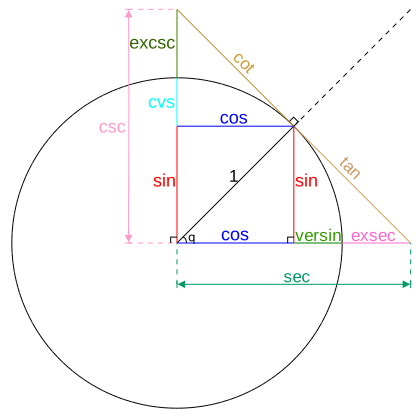
At its core, trigonometry defines relationships between angles and side lengths using six primary functions: sine (sin), cosine (cos), tangent (tan), cotangent (cot), secant (sec), and cosecant (csc). For a right triangle, the sine of an angle is the ratio of the length of the side opposite the angle to the length of the hypotenuse (sin θ = opposite/hypotenuse). The cosine is the ratio of the adjacent side to the hypotenuse (cos θ = adjacent/hypotenuse), and the tangent is the ratio of the opposite side to the adjacent side (tan θ = opposite/adjacent). These fundamental ratios, when extended to angles beyond 90 degrees and even to negative values, form the basis of calculus, Fourier analysis, and countless other mathematical and scientific disciplines, allowing for the modeling of periodic phenomena.
📊 Key Facts & Numbers
Trigonometry is not just theoretical; its applications are vast and quantifiable. For instance, the precise calculation of distances in surveying can achieve accuracies of millimeters over kilometers. In astronomy, parallax measurements using trigonometry allow astronomers to determine distances to stars, with the nearest stars being up to 4.37 light-years away. The development of Global Positioning System relies on trilateration, a geometric technique fundamentally based on trigonometric principles, enabling location accuracy within meters. Furthermore, the study of wave mechanics in physics, from sound waves to electromagnetic radiation, is heavily dependent on sinusoidal functions, which are central to trigonometry.
👥 Key People & Organizations
Key figures who shaped trigonometry include Hipparchus, who compiled the first known trigonometric tables around 150 BC, and Ptolemy, whose Almagest (c. 150 AD) contained extensive trigonometric calculations for astronomy. Later, Al-Biruni (973–1048) made significant contributions, including the development of the spherical sine rule. In Europe, Regiomontanus (1436–1476) was instrumental in separating trigonometry from astronomy, publishing De triangulis omnimodis, which treated trigonometry as a distinct mathematical subject. Modern advancements owe much to mathematicians like Leonhard Euler, who provided modern notation and definitions for trigonometric functions, and Joseph Fourier, whose work on Fourier series revolutionized signal processing and analysis.
🌍 Cultural Impact & Influence
The cultural resonance of trigonometry is profound, though often unseen. It is the silent architect behind much of our technological infrastructure, from the internet's fiber optic cables to the precise trajectories of space missions. Its principles are embedded in the algorithms that render 3D graphics in video games and CAD software, shaping our visual digital world. The very concept of measuring and understanding spatial relationships, a core human endeavor, is deeply intertwined with trigonometric thought, influencing art, architecture, and cartography for millennia, from the construction of the pyramids to the mapping of the globe.
⚡ Current State & Latest Developments
In 2024, trigonometry remains an indispensable tool, constantly being integrated into new technological frontiers. Machine learning algorithms, particularly in areas like computer vision and NLP, utilize trigonometric functions for tasks such as feature extraction and pattern recognition. The ongoing development of quantum computing also involves complex mathematical frameworks where trigonometric concepts play a role in describing quantum states and operations. Furthermore, advancements in virtual reality and augmented reality depend on sophisticated real-time trigonometric calculations to render immersive and interactive environments, pushing the boundaries of digital experience.
🤔 Controversies & Debates
While trigonometry is a well-established field, debates persist regarding pedagogical approaches. Some educators argue for a more intuitive, application-driven introduction to trigonometric concepts, moving away from rote memorization of identities. Others champion the traditional, rigorous approach, emphasizing the foundational importance of understanding the underlying mathematical proofs and derivations. A persistent challenge is the perceived abstractness of trigonometry for some students, leading to discussions about how best to illustrate its tangible relevance in fields like engineering and physics to foster deeper engagement and understanding.
🔮 Future Outlook & Predictions
The future of trigonometry is inextricably linked to the evolution of computational power and data analysis. As we delve deeper into complex systems, from climate modeling to biological simulations, the ability of trigonometry to describe periodic and cyclical behaviors will become even more critical. Expect to see its application expand in areas like bioinformatics, where analyzing cyclical gene expression patterns is vital, and in the development of more sophisticated AI models capable of understanding and generating complex, dynamic data. The ongoing quest for more efficient algorithms will likely refine how trigonometric computations are performed, potentially leading to breakthroughs in speed and accuracy for real-time applications.
💡 Practical Applications
Trigonometry's practical applications are ubiquitous. In civil engineering, it's essential for calculating angles and forces in bridges and buildings. Aeronautical engineers use it to determine flight paths and aerodynamic forces. Electrical engineers rely on it to analyze alternating current (AC) circuits, where voltage and current vary sinusoidally. Medical imaging technologies like CT scans and MRIs employ trigonometric principles for reconstructing images from projection data. Even in everyday tools like smartphones, trigonometry powers features such as screen rotation and AR overlays.
Key Facts
- Category
- science
- Type
- concept